

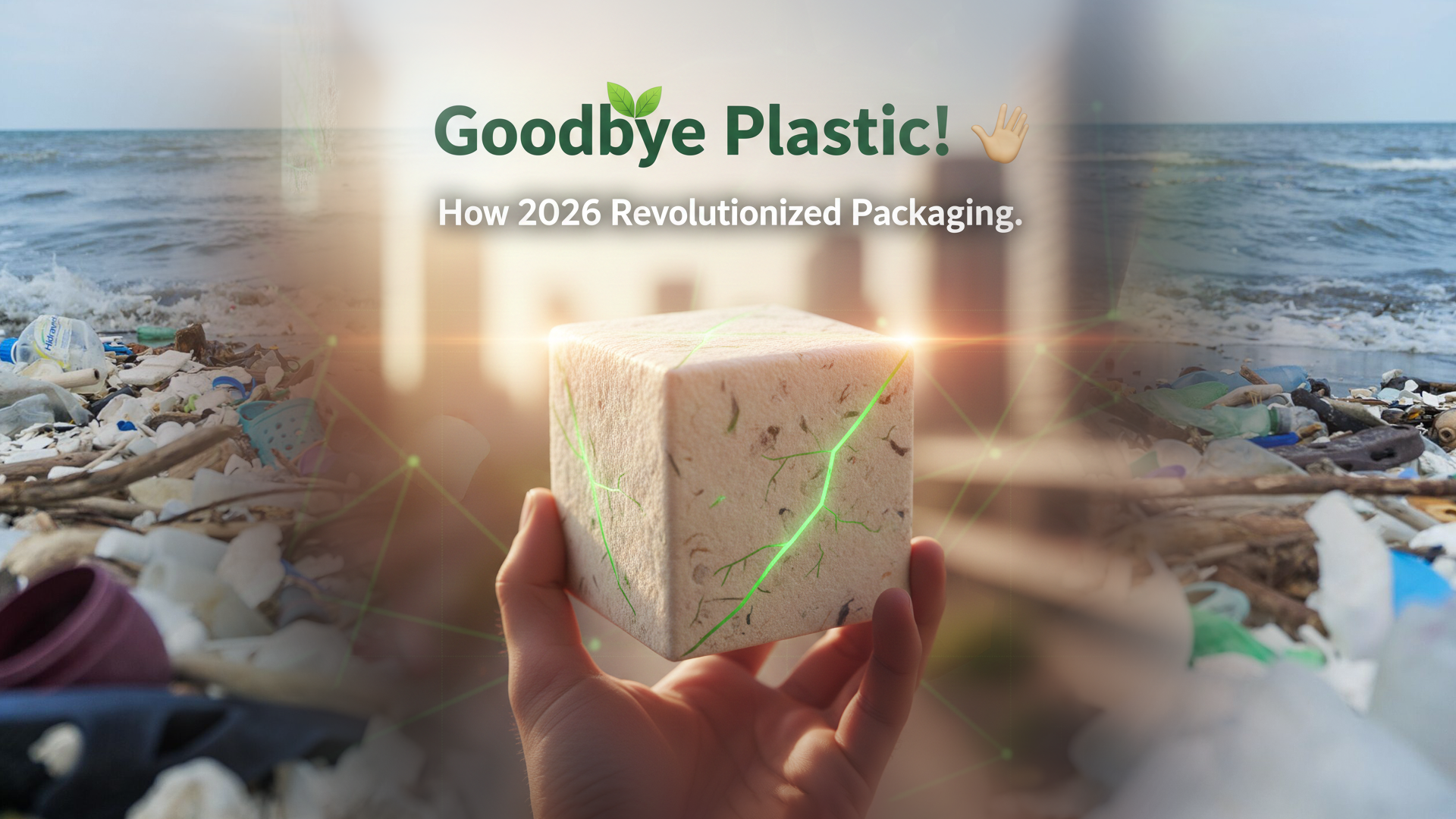
Discover how 2026 marked a global turning point for plastic-free packaging. Learn about the breakthrough innovations and pioneering brands making sustainable choices the new standard.

For decades, the global supply chain was addicted to single-use plastics. However, as we move through 2026, we are witnessing a historic “Plastic Reckoning.” Driven by the EU’s EmpCo Directive and the UK’s Extended Producer Responsibility (EPR) schemes, the industry has finally shifted from “greenwashing” to genuine implementation.

The Material Revolution: Beyond Recycled Plastic
In 2026, the focus has moved away from simply “recycling” toward bio-based alternatives.
- Mycelium & Seaweed: Innovations like Vivomer (a natural polymer) and seaweed-based films have replaced traditional poly-bags. These materials don’t just sit in landfills; they decompose faster than a banana peel.
- Fibre-Based Solutions: “Paperization” is the trend of the year. High-strength corrugated cardboard and molded pulp are now the primary protectors for everything from wine bottles to smartphones.
The Brands Leading the Charge
Several global giants have set the standard for Plastic-Free Packaging in 2026:
- Patagonia: By joining the Pack4Good initiative, they have successfully eliminated all plastic from their shipping lines, opting for regenerative fiberboard.
- Apple: Having reached their goal of 100% fiber-based packaging, Apple’s unboxing experience is now entirely plastic-free, including the internal cable wraps.
- Unilever & Nestlé: These giants have scaled up Smart Packaging, using QR codes to help consumers track the “circularity” of their containers.
Why Plastic-Free Packaging is Winning in 2026
The shift isn’t just moral; it’s economic. In 2026, non-recyclable materials face a 20% fee increase, set to rise to 100% by 2028. Brands that don’t adapt are literally paying the price. Meanwhile, consumers are rewarding “Minimalist Luxury”—the idea that a lightweight, paper-based box is more premium than a heavy, plastic-laden one.
The Future: Circularity as the Standard
As we look toward 2027, the goal is a closed-loop system. This means every piece of packaging is either home-compostable or part of a deposit-return scheme. The “Year of Plastic-Free Packaging” isn’t just a trend; it’s the new baseline for doing business in a conscious world.