


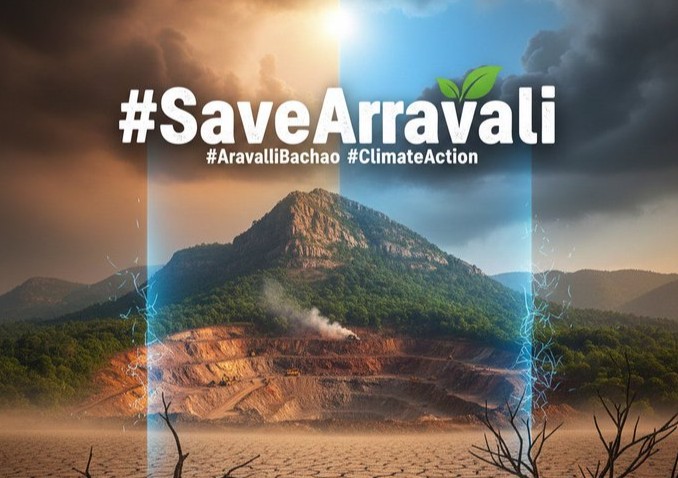
New Delhi: The hashtag Save Aravalli trended widely on social media on Friday as protests erupted across parts of North India following a recent Supreme Court ruling that redefined the legal classification of the Aravalli Hills, triggering concerns among environmentalists, civil society groups, and political leaders about its ecological impact.
The ruling, delivered earlier this week, upheld a revised definition of the Aravalli range based on recommendations by the Ministry of Environment, Forest and Climate Change (MoEFCC). Under the new interpretation, only landforms rising at least 100 metres above the surrounding terrain will be considered part of the Aravalli Hills for regulatory purposes.
Environmental groups argue that the decision could exclude a significant portion of the ancient mountain range from statutory protection, potentially opening large areas to mining, construction, and other development activities.
Why the Ruling Has Sparked Opposition
Stretching across Gujarat, Rajasthan, Haryana, and Delhi, the Aravalli range is among the oldest geological formations in the world and plays a crucial role in preventing desertification, recharging groundwater, and regulating climate conditions in the region.
Experts say that many ecologically sensitive hillocks and ridges fall below the 100-metre threshold and would no longer qualify for protection under existing environmental laws.
“This definition overlooks the ecological function of smaller hills, which are vital for water recharge and act as a natural barrier against the spread of the Thar Desert,” said an environmentalist associated with a Delhi-based conservation group.
According to conservationists, dilution of protection norms could worsen groundwater depletion, increase dust and air pollution in the Delhi-NCR region, and accelerate land degradation in Rajasthan and Haryana.
Protests and Public Mobilisation
Following the ruling, protests were reported from several locations in Rajasthan and the National Capital Region. Demonstrators gathered in towns including Jaipur and Kotputli, raising slogans and carrying placards demanding restoration of comprehensive protection for the Aravalli range.
Civil society organisations have also launched coordinated campaigns under banners such as ‘Aravalli Virasat Jan Abhiyaan’, urging the Supreme Court to reconsider the definition and calling for stronger legal safeguards.
On social media platforms, hashtags including #SaveAravalli and #AravalliUnderThreat were widely shared, with users posting photographs, videos, and statements highlighting the ecological importance of the hills.
Political Reactions
The ruling has drawn reactions from political leaders across party lines. Former Rajasthan Chief Minister Ashok Gehlot criticised the decision, describing it as a move that could severely damage the fragile ecosystem of the region.
“Reducing protection for the Aravalli Hills is equivalent to signing their ecological death certificate,” Gehlot said in a post on X, urging authorities to review the implications of the judgment.
Several opposition leaders echoed similar concerns, calling for a balance between development and environmental conservation. Some leaders also changed their social media profile pictures in support of the Save Aravalli campaign, lending visibility to the movement.
Expert Concerns
Environmental experts have warned that weakening legal protections could encourage illegal mining and unregulated construction, activities that have historically caused extensive damage to the Aravalli range.
“The Aravallis are not just hills; they are a living system that supports biodiversity, groundwater recharge, and climate regulation,” said a senior conservation expert. “Any dilution in protection will have long-term consequences.”
Experts have also pointed out that the hills play a critical role in controlling dust storms and heat waves affecting northern India, particularly during summer months.
Court’s Position
The Supreme Court, while delivering the ruling, stated that the revised definition was necessary to ensure clarity in enforcement and to facilitate sustainable mining practices. The court also directed authorities to prepare a Management Plan for Sustainable Mining (MPSM) before granting new mining leases in affected areas.
Supporters of the decision argue that it aims to strike a balance between environmental protection and economic development, particularly in mineral-rich regions.
What Lies Ahead
Despite these assurances, environmental groups maintain that the ruling could set a precedent for narrowing ecological protections through technical classifications.
As protests continue and public pressure mounts, activists say they plan to submit representations to the central government and seek further judicial review.
The Save Aravalli movement has now emerged as a focal point in the broader debate over environmental governance, development priorities, and the role of legal definitions in protecting India’s natural heritage.
Whether the ruling will be revisited remains uncertain, but the widespread reaction highlights growing public engagement on environmental issues across the country.