


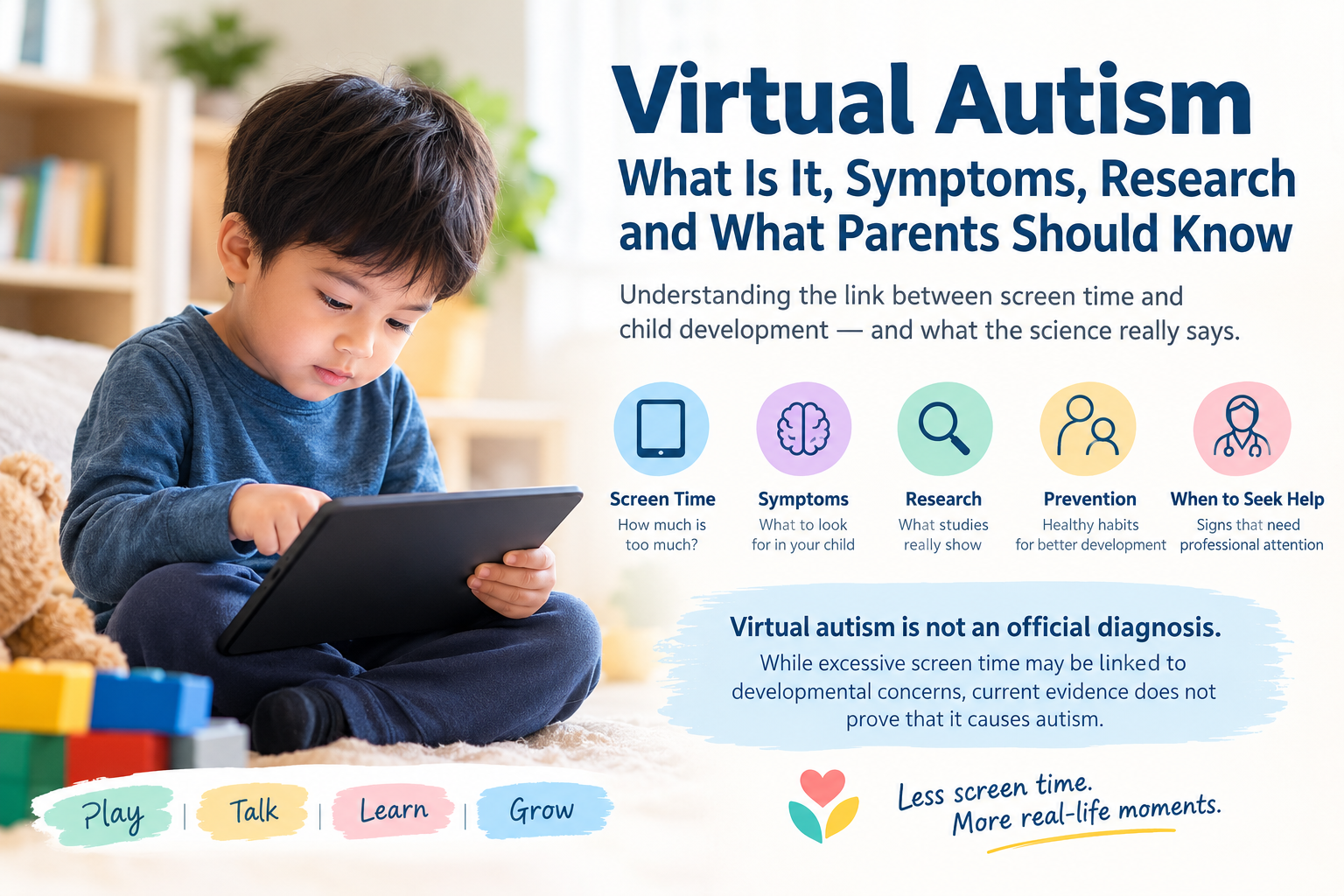
Virtual Autism: Why This Term Is Getting Attention
The term “virtual autism” has become increasingly common in discussions about children’s screen use, particularly among parents concerned about smartphones, tablets, television and other digital devices.
The phrase is generally used to describe autism-like behaviors or developmental difficulties observed in some young children who have had high levels of screen exposure, especially during the early years of life.
However, there is an important distinction that parents need to understand.
Virtual autism is not currently an official medical diagnosis of autism spectrum disorder (ASD). A 2026 article published in the journal Autism specifically cautioned that the term can create confusion because it may incorrectly suggest that screen exposure causes autism. The authors suggested that terms such as “screen-related developmental delay” may be more precise when discussing environmental developmental effects.
At the same time, research does suggest that heavy or prolonged screen exposure in early childhood can be associated with developmental concerns, including problems involving language, communication, attention, social interaction and emotional regulation.
So, what does the science actually tell us?
What Is Virtual Autism?
“Virtual autism” is a relatively new, non-clinical term used to describe a pattern of autism-like behaviors that some researchers and clinicians have associated with prolonged or excessive exposure to digital screens during early childhood.
Children described in discussions about virtual autism may show behaviors such as:
- Delayed speech or limited vocabulary
- Reduced eye contact
- Less interest in face-to-face interaction
- Difficulty participating in social play
- Short attention span
- Irritability when a device is removed
- Repetitive behaviors
- Difficulty following instructions
- Reduced interest in toys or physical activities
- Preference for videos or digital games over human interaction
- Sleep disturbances
- Difficulty communicating needs
But these behaviors do not automatically mean that a child has autism.
Several developmental conditions can produce overlapping symptoms. A child with a speech or language delay, hearing problem, developmental delay, attention difficulties or other developmental concerns may also display behaviors that resemble some features of autism.
That is why professional developmental assessment is important.
Is Virtual Autism Actually Autism?
No—not as a recognized clinical diagnosis.
Autism spectrum disorder is a neurodevelopmental condition involving differences in social communication and interaction, along with restricted or repetitive patterns of behavior or interests. The World Health Organization describes autism as a diverse group of conditions related to brain development.
The causes of autism are complex. Scientific evidence points toward a combination of genetic and environmental factors, rather than one simple cause. WHO notes that research has identified several factors associated with autism risk, while emphasizing that more research is needed to understand how different factors interact with genetic variation.
Therefore, it would be inaccurate to say:
“Screen time causes autism.”
Current evidence does not support that conclusion.
A more accurate statement is:
High screen exposure in early childhood has been associated in some studies with autism-like symptoms and developmental difficulties, but association does not prove that screen exposure causes autism.
The distinction is extremely important for parents.
What Does Research Say About Screen Time and Autism?
Research on this subject is growing, but the results are not completely consistent.
A 2023 systematic review examined studies investigating early screen exposure and the risk of autism spectrum disorder. The review found that several studies reported an association between greater or earlier screen exposure and autism-related outcomes, but it also acknowledged that available evidence was insufficient to establish a definitive causal relationship.
Another major systematic review and meta-analysis published in JAMA Network Open examined 46 studies involving 562,131 participants.
The researchers initially found a positive association between screen use and ASD or ASD symptoms. However, after accounting for publication bias, the association became substantially smaller and statistically non-significant. The authors concluded that the existing evidence did not sufficiently support a claimed association between screen use and ASD, while emphasizing that excessive screen use can still pose developmental risks and that more research is required.
This is one of the most important findings for understanding the debate.
What the research does suggest
There is evidence that excessive screen exposure can interfere with activities that are important for early development, including:
- Talking with parents
- Face-to-face communication
- Interactive play
- Reading
- Physical activity
- Sleep
- Social interaction
The American Academy of Pediatrics notes that studies have linked higher daily screen use with more autism-like symptoms in young children, but emphasizes that most of those studies used autism screening tests rather than actual autism diagnoses.
That difference matters.
A screening result is not the same as a medical diagnosis.
Why Early Childhood Is So Important
The first few years of life are a critical period for brain and language development.
Children learn through interaction.
A baby learns communication by looking at a parent’s face, listening to speech, responding to expressions and participating in back-and-forth interaction.
A toddler develops language by hearing words repeatedly, pointing at objects, asking questions, playing games and interacting with other people.
If large amounts of a child’s waking time are spent passively watching a screen, there may be less time available for these experiences.
This is sometimes described as “displacement”: screen time does not necessarily harm development directly, but it may replace activities that are beneficial for development.
WHO’s guidance for children under five emphasizes reducing sedentary screen time while increasing physical activity, sleep and interactive non-screen activities such as reading, storytelling, singing and puzzles.
What Are the Possible Signs Associated With Excessive Screen Exposure?
Parents may notice several developmental or behavioral changes when a young child spends excessive amounts of time with screens.
1. Speech and Language Delay
A child may speak less, use fewer words or show limited interest in verbal interaction.
However, speech delay has many possible causes and should not automatically be attributed to screen use.
2. Reduced Social Interaction
Some children may become more interested in videos and games than playing with parents, siblings or other children.
3. Reduced Eye Contact
A child may spend more time focusing on a screen and less time looking at people during communication.
4. Difficulty With Attention
Rapidly changing videos and highly stimulating digital content may make ordinary activities appear less interesting to some children.
5. Irritability and Tantrums
Some children become upset when a device is taken away, particularly when screen use has become part of their daily routine.
6. Sleep Problems
Using screens late in the day can interfere with healthy sleep routines, while insufficient sleep can affect behavior, attention and emotional regulation.
7. Reduced Physical Activity
Long periods of sitting with a phone, tablet or television can reduce opportunities for active play.
8. Less Imaginative or Interactive Play
A child who spends most free time consuming digital content may have fewer opportunities for physical, pretend and social play.
These signs should be considered developmental warning signs, not proof of virtual autism or autism spectrum disorder.
How Much Screen Time Is Too Much?
There is no single number that can determine whether a child will develop autism or a developmental disorder.
However, international health guidance provides useful boundaries.
According to WHO:
- Infants under 1 year: sedentary screen time is not recommended.
- 1-year-olds: sedentary screen time is not recommended.
- 2-year-olds: no more than 1 hour per day; less is better.
- Children aged 3–4 years: no more than 1 hour per day; less is better.
The emphasis is not simply on counting minutes.
What children do instead of using screens is equally important.
Reading with a parent, talking, singing, drawing, playing outdoors, building blocks and participating in family activities provide opportunities for communication and learning that passive screen viewing cannot fully replace.
Is Screen Time the Same for Every Child?
No.
The effect of screen use can depend on:
- The child’s age
- Duration of use
- Type of content
- Whether the child watches alone
- Whether parents participate
- Time of day
- Sleep patterns
- Physical activity
- Existing developmental difficulties
- Family environment
- Overall quality of interaction
Interactive screen use with a parent is different from leaving a young child alone with a device for several hours.
The American Academy of Pediatrics also stresses that research in this area is complicated by the possibility of reverse causation. For example, a child who already has developmental differences may prefer screens, or parents may use screens to calm, occupy or teach a child who is already experiencing developmental difficulties.
This makes it difficult to determine which came first.
Research From India
The discussion around screen exposure and autism-like behaviors has also appeared in Indian medical and academic literature.
A 2024 article by researchers affiliated with AIIMS Rajkot discussed early screen exposure and developmental abnormalities associated with the term “virtual autism.” The authors emphasized the need to understand the concept carefully and distinguish screen-related developmental concerns from established autism spectrum disorder.
Another 2024 publication from researchers in Uttar Pradesh discussed “virtual autism” in relation to gadget exposure and preventive measures.
More recent Indian research has continued investigating screen exposure and autism-like features. A 2026 study published in the International Journal of Indian Psychology reported an association between prolonged early screen exposure and several developmental and behavioral concerns, while calling for continued research into the issue.
These publications contribute to the discussion, but they should not be interpreted as proof that screens cause autism.
The Important Difference Between Autism and Screen-Related Developmental Problems
| Autism Spectrum Disorder | Screen-Related Developmental Concerns |
|---|---|
| Recognized neurodevelopmental condition | Not an official diagnosis |
| Complex biological and developmental basis | Often discussed in relation to environmental habits |
| Symptoms can appear early in childhood | May be associated with prolonged screen exposure |
| Requires professional assessment | Requires evaluation of the child’s overall development |
| Screen reduction does not “cure” autism | Changing routines may improve some developmental behaviors |
| Individual support needs vary | Intervention depends on the child’s specific difficulties |
This distinction is essential because calling every screen-related developmental problem “autism” can create unnecessary fear and may delay appropriate evaluation.
Can Reducing Screen Time Improve Symptoms?
Reducing excessive screen use can be beneficial for many children, particularly when screen time has replaced sleep, physical activity, family interaction or play.
Some children may show improvements in:
- Attention
- Communication
- Sleep
- Social interaction
- Behavior
- Interest in physical play
- Family engagement
But parents should be careful about the word “cure.”
Reducing screen exposure should not be presented as a treatment or cure for autism spectrum disorder.
If a child has autism, reducing screen time may be part of a healthy routine, but autism itself requires appropriate developmental assessment and individualized support.
What Parents Can Do
Parents do not need to eliminate every screen from a child’s life.
Instead, the goal should be to build a healthier balance.
Create Screen-Free Periods
Keep specific parts of the day free from smartphones, tablets and television.
Avoid Screens During Meals
Mealtimes can become valuable opportunities for conversation and family interaction.
Protect Sleep
Establish a consistent bedtime routine and avoid allowing devices to dominate the period immediately before sleep.
Encourage Outdoor Play
Running, walking, cycling, playground activities and simple physical games support physical and social development.
Talk to Your Child
Narrate everyday activities.
For example:
“Let’s wash your hands.”
“This is a red ball.”
“Where is your shoe?”
Simple conversations provide opportunities for language development.
Read Together
Books encourage listening, vocabulary, attention and interaction.
Play Face-to-Face
Building blocks, pretend play, puzzles, drawing and simple games allow children to learn through interaction.
Do Not Use Screens as the Only Way to Calm a Child
Occasional use can be practical, but children also need opportunities to learn other ways to manage boredom, frustration and emotions.
When Should Parents Consult a Doctor?
Parents should not wait for a child to “outgrow” a significant developmental concern.
Consider speaking with a pediatrician or qualified developmental professional if a child:
- Is not developing expected language skills
- Stops using words they previously used
- Does not respond consistently to their name
- Shows significant difficulty with social interaction
- Has unusual repetitive behaviors
- Does not engage in age-appropriate play
- Shows major developmental regression
- Has significant hearing or communication concerns
- Has persistent behavioral or developmental difficulties
The CDC states that autism can sometimes be detected by 18 months or younger, and recommends autism-specific screening at 18 and 24 months, alongside broader developmental screening at recommended well-child visits.
Early assessment does not mean that a child will necessarily receive an autism diagnosis.
It means that developmental concerns can be identified and addressed sooner.
Why Parents Should Not Blame Themselves
The debate surrounding virtual autism can sometimes create unnecessary guilt.
Parents may wonder:
“Did I cause this because I gave my child a phone?”
The available evidence does not justify that conclusion.
Autism is a complex neurodevelopmental condition. WHO describes multiple factors associated with autism and emphasizes the complexity of its causes.
At the same time, parents can still make meaningful changes to a child’s environment.
Reducing excessive screen exposure, increasing interaction and improving sleep and physical activity are reasonable steps for healthy childhood development regardless of whether a child has autism.
What the Latest Research Really Tells Us
The evidence can be summarized in five points:
1. “Virtual autism” is not an established clinical diagnosis.
2. Excessive screen exposure has been associated with developmental and autism-like symptoms in some studies.
3. Current evidence does not prove that screen exposure causes autism.
4. Some studies are affected by confounding and reverse causation, because children with developmental differences may themselves have different patterns of screen use.
5. Reducing excessive screen time and increasing face-to-face interaction, physical activity, sleep and play are sensible approaches to supporting healthy child development.
A particularly important development came in 2026, when researchers writing in Autism argued that the term “virtual autism” should be used cautiously because it may unintentionally reinforce the incorrect idea that autism is caused by screens or that parents are responsible for causing autism.
Frequently Asked Questions About Virtual Autism
Is virtual autism a real medical diagnosis?
No. “Virtual autism” is not currently an official clinical diagnosis. It is a term used in some research and public discussions to describe autism-like developmental behaviors associated with heavy screen exposure.
Can too much screen time cause autism?
Current evidence does not establish that screen time causes autism. Research has found associations between high screen exposure and autism-like symptoms or developmental difficulties, but causation remains uncertain.
What are the symptoms of virtual autism?
People using the term may refer to speech delay, reduced social interaction, limited eye contact, attention difficulties, irritability, repetitive behaviors and preference for screens. However, these signs can have many causes.
Can virtual autism be reversed?
Some screen-related behavioral or developmental difficulties may improve when excessive screen use is reduced and children receive more opportunities for sleep, play, communication and social interaction. This should not be confused with a “cure” for autism.
How much screen time should a 2-year-old have?
WHO recommends no more than one hour of sedentary screen time per day for 2-year-olds, with less being better.
Should babies use smartphones or tablets?
WHO does not recommend sedentary screen time for infants under one year.
What should parents do if their child has autism-like symptoms?
Do not rely on internet descriptions alone. Speak with a pediatrician or qualified developmental professional and request developmental screening when appropriate.
Final Word: Focus on the Child, Not the Label
The growing discussion about virtual autism highlights a genuine concern: young children are spending increasing amounts of time around digital devices, while early childhood development depends heavily on communication, interaction, movement, sleep and play.
But the terminology matters.
Calling every developmental difficulty caused or associated with excessive screen exposure “autism” can create confusion.
The strongest evidence currently supports a more careful approach:
Limit excessive screen exposure, protect sleep, encourage active play, talk and read with children, create opportunities for face-to-face interaction, and seek professional developmental assessment when concerns arise.
Most importantly, parents should remember that screen exposure and autism are not interchangeable concepts.
The goal should not be to blame parents, screens or children.
The goal should be to understand the evidence, identify developmental concerns early and give every child the opportunity to communicate, play, learn and develop in a supportive environment.
