


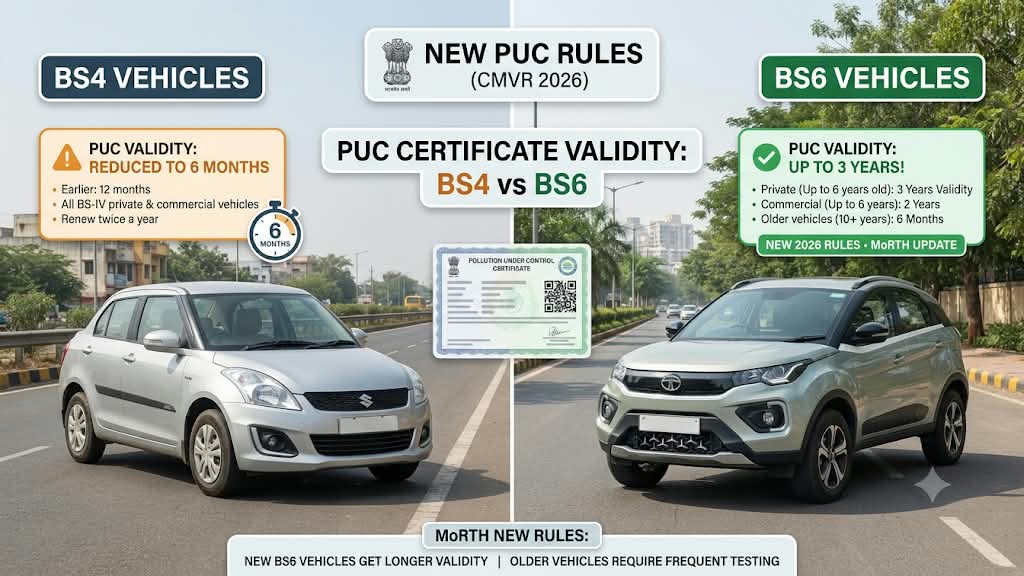
PUC New Rules 2026: If you own a car, bike, or scooter in India, there is an important update you should know about. The Central Government has revised the rules regarding Pollution Under Control (PUC) certificates. Under the new regulations, the validity of a PUC certificate will depend on the vehicle’s Bharat Stage (BS) emission standard, age, and category.
According to the revised rules, BS4 vehicles will need to undergo pollution testing every six months. Meanwhile, BS6 vehicle owners may receive significant relief, as newer private BS6 vehicles can get a PUC certificate valid for up to three years.
The Ministry of Road Transport and Highways (MoRTH) has notified these changes under the Central Motor Vehicles (Sixteenth Amendment) Rules, 2026, through Government Notification G.S.R. 991(E), dated November 13, 2026.
These changes are important for millions of vehicle owners across the country. Whether you own a petrol car, diesel vehicle, motorcycle, or scooter, you should understand the new PUC rules to avoid unnecessary problems.
Let’s take a detailed look at the revised PUC certificate validity, BS4 and BS6 vehicle rules, online certificate checking process, and other important details.
1. What Are the New PUC Rules 2026?
The Central Government has revised the validity period of Pollution Under Control certificates to improve vehicle emission monitoring across India.
Under the revised framework, different PUC validity periods have been prescribed according to the vehicle’s emission standard, age, and usage category.
The new rules cover vehicles following BS1, BS2, BS3, BS4, and BS6 emission standards.
One of the biggest changes concerns BS6 vehicles. Private BS6 vehicles up to six years old may receive a PUC certificate valid for three years. Vehicles above six years and up to ten years old will have one-year validity, while vehicles older than ten years will have six-month validity.
The objective is to reduce frequent visits to pollution testing centres for newer vehicles while ensuring regular emission checks for older vehicles.
2. BS4 Vehicles Must Undergo Pollution Testing Every 6 Months
If you own a BS4 petrol or diesel car, motorcycle, or scooter, you should pay attention to the revised regulations.
According to the new rules, BS4 vehicles will have a PUC certificate validity of six months.
This means vehicle owners will need to visit an authorised pollution testing centre every six months to get their vehicle’s emissions checked and renew their PUC certificate.
This requirement is not limited to cars. Other motor vehicles complying with BS4 emission standards are also covered.
For example, if you own a BS4 petrol car or motorcycle, you will need to renew your PUC certificate every six months.
Vehicle owners should regularly check the expiry date printed on their existing PUC certificates to avoid penalties or inconvenience.
3. BS6 Vehicle Owners Get Major Relief
One of the important features of the revised PUC regulations is the longer certificate validity provided to certain BS6 vehicles.
The validity period will depend on the age of the vehicle and whether it is used privately or commercially.
New PUC Rules for Private BS6 Vehicles
For private BS6 vehicles, the revised validity periods are as follows:
- Vehicles up to 6 years old: 3 years of PUC validity.
- Vehicles above 6 years and up to 10 years old: 1 year of PUC validity.
- Vehicles more than 10 years old: 6 months of PUC validity.
The vehicle’s age will be calculated from its first registration date.
This change is expected to reduce the frequency of PUC renewals for owners of newer BS6 cars, motorcycles, and scooters.
However, this does not mean BS6 vehicle owners are permanently exempt from pollution testing. They must obtain a valid certificate according to the prescribed schedule.
4. What Are the New Rules for BS6 Commercial Vehicles?
The revised regulations also provide separate validity periods for commercial BS6 vehicles.
Commercial vehicles include taxis, goods carriers, and other vehicles used for transportation and business purposes.
The revised validity periods are:
- BS6 commercial vehicles up to 6 years old: 2 years.
- Vehicles above 6 years and up to 10 years old: 1 year.
- Vehicles more than 10 years old: 6 months.
This means newer BS6 commercial vehicles may also receive relief from frequent PUC renewals.
Taxi operators, transport businesses, and goods vehicle owners should regularly check their registration details and PUC expiry dates.
5. BS1, BS2 and BS3 Vehicles Must Undergo Testing Every 3 Months
The government has prescribed a shorter PUC validity period for vehicles following older emission standards.
According to the revised rules, BS1, BS2, and BS3 vehicles will have a PUC certificate validity of three months.
This means owners of these vehicles will need to undergo pollution testing every three months.
The measure is intended to ensure more frequent monitoring of emissions from older vehicles.
If you own an older BS1, BS2, or BS3 car or motorcycle, you should be prepared for more frequent PUC renewals.
6. Complete List of New PUC Certificate Validity Rules
Here is a summary of the revised PUC certificate validity periods according to vehicle category and age.
| Vehicle Category | PUC Certificate Validity |
|---|---|
| BS1, BS2 and BS3 vehicles | 3 months |
| BS4 vehicles | 6 months |
| Private BS6 vehicles up to 6 years | 3 years |
| Private BS6 vehicles above 6 and up to 10 years | 1 year |
| Private BS6 vehicles above 10 years | 6 months |
| Commercial BS6 vehicles up to 6 years | 2 years |
| Commercial BS6 vehicles above 6 and up to 10 years | 1 year |
| Commercial BS6 vehicles above 10 years | 6 months |
The vehicle’s age will be calculated from the date of its first registration.
7. What Happens to Existing PUC Certificates?
Many vehicle owners may wonder whether their existing PUC certificates will automatically receive an extended validity period after the new rules come into effect.
The answer is no.
According to the notification, PUC certificates issued before the implementation of the revised rules will continue to remain valid. The new validity provisions will apply when the certificate is renewed for the first time after the revised rules come into effect.
For example, if a BS6 private vehicle already has a valid PUC certificate, it will not be cancelled immediately. The new validity period will be determined at the time of its next renewal.
Therefore, vehicle owners should check the expiry date of their existing certificates rather than assuming that their validity has automatically increased.
8. Renew Your PUC Certificate Before It Expires
The revised rules also provide an important provision regarding the renewal of PUC certificates.
If a vehicle owner applies for renewal within the last 10 days before the existing certificate expires, the new certificate will take effect from the expiry date of the previous certificate.
However, if the PUC certificate has already expired, the renewed certificate will take effect from the date of renewal.
This makes it important for vehicle owners to complete their pollution testing on time.
Do not wait until the last day to visit a PUC testing centre. Renewing the certificate before expiry can help avoid unnecessary complications.
9. Why Is a PUC Certificate Important?
PUC stands for Pollution Under Control. It is an official certificate that indicates whether a vehicle’s emissions are within the prescribed pollution limits.
With the growing number of cars, motorcycles, buses, and trucks on Indian roads, vehicle emissions have become an important environmental concern.
Vehicle exhaust can contain harmful pollutants such as carbon monoxide, hydrocarbons, and nitrogen oxides.
These pollutants can contribute to air pollution and affect public health.
To control vehicle emissions, the government has established specific emission standards for vehicles.
During a PUC test, the exhaust emissions of a vehicle are checked using authorised testing equipment.
If the vehicle meets the prescribed emission standards, a PUC certificate is issued.
Therefore, a PUC certificate is not just another document. It is an important part of India’s vehicle pollution control system.
10. How to Check Your PUC Certificate Online
Vehicle owners can also access their PUC certificate details online through the official Parivahan portal.
Follow these steps to check your PUC certificate:
- Visit the official Parivahan PUC website.
- Open the PUC Certificate section.
- Enter your vehicle registration number.
- Provide the required information.
- Check the available certificate details and validity.
- Download or print the certificate if the option is available.
Official Website: https://puc.parivahan.gov.in/puc/
The information displayed will depend on the records available on the portal.
11. Where Can You Get a PUC Test Done?
You can get your vehicle’s pollution test done at an authorised PUC testing centre.
These centres are available at several petrol pumps and authorised vehicle emission testing stations across India.
To complete the test, you generally need to take your vehicle to the testing centre and provide its registration details.
The testing process involves checking the emissions coming from the vehicle’s exhaust system.
If the vehicle meets the prescribed pollution standards, the authorised centre issues a PUC certificate.
Vehicle owners should always use authorised testing centres to avoid invalid or fraudulent certificates.
12. What Is the Fine for Driving Without a Valid PUC Certificate?
Having a valid PUC certificate is an important legal requirement for vehicle owners in India.
Under Section 190(2) of the Motor Vehicles Act, 1988, penalties may apply for violations involving prescribed pollution and emission standards.
Driving a vehicle without complying with applicable emission requirements can lead to legal action and financial penalties.
Vehicle owners should not continue driving with an expired PUC certificate.
The applicable penalty and enforcement process may depend on the relevant legal provisions and local transport department procedures.
The safest option is to renew your PUC certificate before its expiry date.
13. What Is the Difference Between BS4 and BS6 Vehicles?
BS stands for Bharat Stage. These are emission standards introduced in India to regulate the amount of pollution produced by motor vehicles.
BS4 and BS6 are two different stages of India’s vehicle emission standards.
BS6 standards are significantly stricter than BS4 standards. Vehicles manufactured under BS6 regulations use improved engine technology and emission control systems to reduce harmful pollutants.
The BS6 emission standards became mandatory for new vehicles sold in India from April 1, 2020.
Because BS6 vehicles follow stricter emission standards, the government has provided longer PUC validity periods for certain newer vehicles under the revised framework.
However, even a BS6 vehicle can produce excessive pollution if it is poorly maintained or has engine-related problems.
Regular servicing and proper maintenance remain important for every vehicle.
14. What Should Vehicle Owners Do Now?
Following the revised PUC regulations, vehicle owners should take a few important steps:
- Check the Bharat Stage emission standard of your vehicle.
- Find out the vehicle’s first registration date.
- Check the expiry date of your existing PUC certificate.
- Understand the revised validity period applicable to your vehicle.
- Get your vehicle tested at an authorised PUC centre.
- Keep a digital or printed copy of your PUC certificate.
- Maintain your vehicle regularly to control emissions.
Owners of older vehicles should pay particular attention because they may need to renew their PUC certificates more frequently.
Conclusion
The new PUC Rules 2026 are important for car, bike, and scooter owners across India.
Under the revised framework, BS4 vehicles will have a PUC certificate validity of six months, while BS1, BS2, and BS3 vehicles will need to undergo testing every three months.
BS6 vehicle owners may receive longer certificate validity depending on the vehicle’s age and whether it is used privately or commercially.
Private BS6 vehicles up to six years old may receive three-year validity, while older vehicles will have shorter validity periods.
The main objective of these changes is to improve pollution control while reducing frequent renewal requirements for newer vehicles.
If you own a car, motorcycle, or scooter, make sure you check its emission standard and PUC expiry date. Get your vehicle tested on time, maintain it properly, and always carry a valid PUC certificate while driving.
