


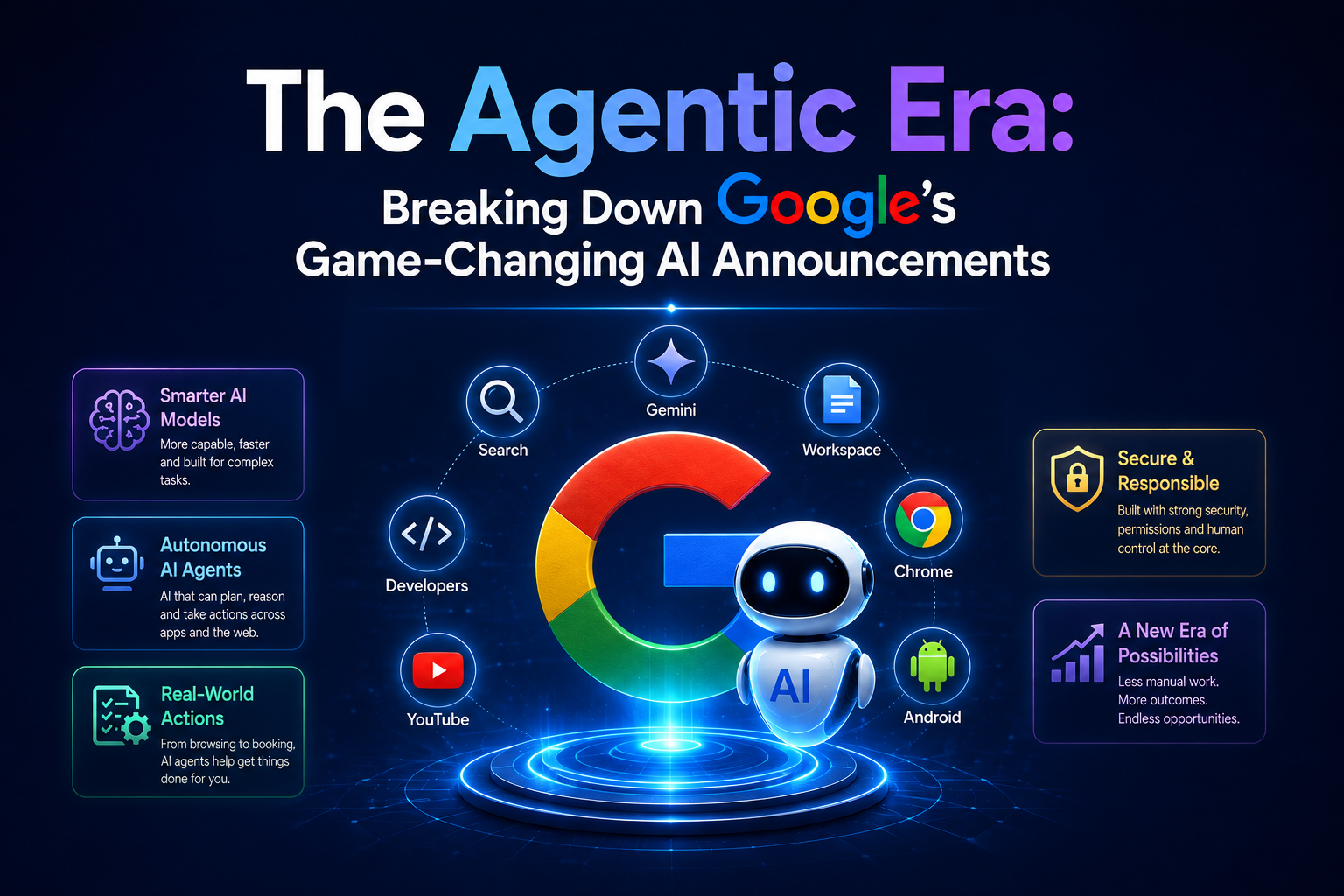
Agentic AI Era: AI Is Moving From Answers to Actions
Artificial intelligence is entering a new phase.
For years, AI assistants have primarily worked as question-and-answer tools. You ask a question, provide a prompt or upload a file, and the AI generates a response.
But the next generation of AI is designed to do much more.
Welcome to the Agentic AI Era—a period in which AI systems are increasingly being designed to reason through complex tasks, plan multiple steps, use digital tools and, with appropriate permissions, take actions on behalf of users.
Google’s latest AI strategy provides one of the clearest examples of this transition. At Google I/O 2026, the company introduced major developments around Gemini 3.5 Flash, Gemini Omni, Gemini Spark and agent-focused development tools, pushing AI deeper into Search, Workspace, Chrome, Android and software development.
But Google isn’t alone.
OpenAI, Anthropic and Microsoft are also building increasingly capable AI agents.
So the big question is:
Is Google actually leading the Agentic AI race, or is it simply competing in a much larger AI battle?
What Is Agentic AI?
Agentic AI refers to AI systems that can go beyond generating a single response and instead work toward a broader objective.
A traditional chatbot might answer:
“Here are five hotels you could consider.”
An agentic system could potentially take the next steps—searching available options, comparing them against your preferences, preparing a shortlist and asking for confirmation before a sensitive action.
The fundamental shift is:
Traditional AI → Answer
Agentic AI → Understand → Plan → Execute → Verify
The more capable these systems become, the less users may need to manually coordinate every step.
Google Gemini 3.5 Flash: Built for Agentic Work
Google’s Gemini 3.5 Flash is positioned as a fast model focused on agentic workflows, coding and complex long-horizon tasks. Google describes it as part of its effort to build more capable AI agents that can deliver real-world utility.
This is important because agentic AI often requires many individual AI operations.
An agent may need to:
- Understand the user’s objective
- Break it into smaller tasks
- Search for information
- Analyze the results
- Use external tools
- Check its own work
- Continue until the task is completed
For these workloads, speed and efficiency can be just as important as raw intelligence.
Google is therefore positioning its Flash models as a potential workhorse for AI agents.
Gemini Omni: Google’s Multimodal AI Push
Another major part of Google’s strategy is Gemini Omni, a multimodal model designed to work across text, audio, images and video.
Google says Gemini Omni can produce dynamic video content by combining different types of inputs and is designed to make video creation and editing more intuitive through natural-language interaction.
This represents an important direction for AI.
Instead of having separate tools for:
- Text generation
- Image creation
- Video creation
- Voice interaction
- Code generation
the long-term vision is to bring these capabilities together into a more unified AI system.
Gemini Spark: A More Proactive AI Assistant
Google is also moving toward the concept of an AI assistant that can remain useful beyond a single conversation.
Gemini Spark is designed as a proactive agent that can help users with ongoing tasks and provide assistance around the clock. Google describes it as part of the next evolution of the Gemini app.
The significance of this idea is bigger than simply having a smarter chatbot.
Instead of:
User → Prompt → AI → Answer
the experience could gradually become:
User → Goal → AI → Background work → Updates → Result
That is one of the defining ideas behind Agentic AI.
Chrome Could Become an AI-Powered Workspace
Google is also bringing AI deeper into the browser.
The idea behind agentic browsing is that AI should not only find websites but also help users complete tasks across them.
Potential use cases include:
- Filling out online forms
- Comparing products
- Tracking orders
- Researching travel
- Managing repetitive web tasks
- Navigating multiple websites
However, autonomous browser activity creates an important requirement: human control.
Actions involving money, accounts, purchases or sensitive information should require appropriate permissions and confirmation.
The future of AI agents will therefore depend not just on intelligence, but also on trust and security.
Google Antigravity: AI Agents for Software Development
Software development is another area where Google’s agentic strategy is becoming particularly interesting.
Google Antigravity is positioned as an agent-focused development environment where AI can participate more deeply in the software development lifecycle.
Instead of asking AI to simply generate a piece of code, developers can increasingly use agents for:
- Writing code
- Testing
- Debugging
- Reviewing
- Running tasks
- Managing development workflows
This changes the role of AI from a coding assistant to a potential AI development team.
Google vs ChatGPT vs Claude vs Microsoft Copilot
Google’s biggest challenge is that it isn’t entering an empty market.
OpenAI, Anthropic and Microsoft are already developing powerful AI assistants and agent platforms.
Here’s how the major players compare.
| Platform | Major Strength | Agentic Direction | Ecosystem Advantage |
|---|---|---|---|
| Google Gemini | Multimodal AI + Search + Android | Gemini agents, Spark, browser and workflow automation | Google Search, Android, Chrome, Gmail, YouTube, Workspace |
| ChatGPT | General-purpose reasoning, research and task assistance | Agentic workflows and computer/tool use | OpenAI ecosystem + broad third-party integrations |
| Claude | Reasoning, writing and software development | Computer use and long-running coding workflows | Strong developer and enterprise focus |
| Microsoft Copilot | Enterprise productivity | Custom agents and computer-using agents | Microsoft 365, Teams, Outlook, Windows and enterprise data |
Google Gemini vs ChatGPT
Gemini’s biggest advantage is ecosystem integration.
Google controls some of the world’s most widely used digital products—including Search, Chrome, Android, Gmail, YouTube and Workspace.
That gives Gemini the potential to operate across a huge amount of the user’s digital life.
ChatGPT, meanwhile, has developed into a broad general-purpose AI platform with strong capabilities across reasoning, writing, coding, research and tool-based workflows.
The difference could increasingly become:
Gemini: AI deeply integrated into Google’s ecosystem.
ChatGPT: AI platform designed to work across a broad range of tasks and tools.
The competition may therefore be less about which chatbot gives the best answer and more about which AI can complete more useful tasks reliably.
Google Gemini vs Claude
Anthropic’s Claude has become particularly strong in coding, reasoning and enterprise-oriented workflows.
Anthropic also provides a computer-use capability that allows Claude-based systems to interact with computer environments using screenshots and mouse/keyboard controls.
Anthropic’s Claude Opus 4.7, released in 2026, is positioned as a major improvement for advanced software development and related tasks.
This puts Claude directly into the same strategic area Google is targeting with its agentic coding initiatives.
The key difference is ecosystem.
Google’s strength: Search, Android, Workspace and multimodal media.
Anthropic’s strength: Enterprise AI, reasoning and developer workflows.
Google Gemini vs Microsoft Copilot
Microsoft is perhaps Google’s most interesting enterprise competitor in Agentic AI.
Microsoft’s Copilot ecosystem already includes custom AI agents, while Copilot Studio allows organizations to build, deploy and manage agents.
Microsoft has also made computer-using agents generally available through Copilot Studio, allowing agents to interact with websites and desktop applications through their user interfaces.
Microsoft’s biggest advantage is its enterprise ecosystem:
Outlook + Teams + Word + Excel + PowerPoint + OneDrive + SharePoint + Windows
Google has a comparable ecosystem through:
Gmail + Docs + Sheets + Drive + Chrome + Android + Search
That makes the Google-Microsoft competition especially important for the future of workplace AI.
The Real AI Competition Is Becoming an Ecosystem Battle
The AI race is no longer simply about building the smartest language model.
It is increasingly about building the best AI ecosystem.
Imagine four companies competing on four different fronts:
Search + Android + Chrome + Workspace + Gemini
OpenAI
ChatGPT + reasoning + agents + tools + integrations
Anthropic
Claude + coding + enterprise + computer use
Microsoft
Copilot + Microsoft 365 + Windows + enterprise agents
The winner may ultimately be the company that can combine:
Intelligence + Tools + Data + Ecosystem + Reliability + User Trust
Why Agentic AI Could Be a Bigger Change Than Chatbots
Generative AI changed how we create information.
Agentic AI could change how we get things done.
Consider a simple example.
Today, planning a business trip might require:
- Searching flights
- Comparing prices
- Checking schedules
- Finding hotels
- Comparing locations
- Checking your calendar
- Preparing an itinerary
- Sending information to colleagues
In an agentic future, you could potentially provide the objective and let an AI system coordinate many of these steps.
The human would increasingly become the decision-maker, while AI becomes the executor.
The Biggest Challenge: Trust
The more powerful AI agents become, the more important safety becomes.
A chatbot giving you an incorrect answer is one problem.
An AI agent taking an incorrect action is a much bigger problem.
Imagine an AI agent:
- Sending the wrong email
- Booking the wrong flight
- Changing an important document
- Purchasing the wrong product
- Sharing sensitive information
- Making an incorrect business decision
This is why the future of Agentic AI will require strong systems for:
Permission
Identity
Privacy
Security
Human confirmation
Auditability
AI must know not only what it can do, but also when it should stop and ask the human.
What Does This Mean for Users?
For everyday users, Agentic AI could eventually reduce the amount of repetitive digital work they have to perform.
For professionals, it could automate research, documentation, communication and data-related tasks.
For developers, AI agents could increasingly participate in the entire software development lifecycle.
For businesses, AI agents could become digital workers capable of handling specific processes under controlled permissions.
And for content creators, multimodal AI could combine writing, images, audio and video into a single workflow.
The Future: From AI Assistant to AI Workforce
The biggest change may be philosophical.
The first generation of AI asked:
“What would you like me to write?”
The next generation asks:
“What would you like me to accomplish?”
That is the essence of the Agentic AI Era.
Google’s Gemini strategy, OpenAI’s agentic capabilities, Anthropic’s computer-use and coding work, and Microsoft’s enterprise agents all point toward the same broad direction: AI is moving from passive interaction toward increasingly active execution.
The battle between Google, OpenAI, Anthropic and Microsoft will therefore not simply be about who has the smartest chatbot.
It will be about who can build the most useful, reliable and trusted AI agent.
Conclusion
The Agentic AI Era is beginning to transform the relationship between humans and software.
Google is betting that Gemini can become the intelligence layer across Search, Chrome, Android, Workspace and other products. OpenAI is pushing ChatGPT toward broader task-oriented assistance. Anthropic is focusing heavily on reasoning, coding and computer interaction, while Microsoft is embedding agents deeply into enterprise workflows.
The ultimate goal is remarkably simple:
Less prompting. Less clicking. Less repetitive work. More completed tasks.
The next generation of AI may not feel like talking to a chatbot.
It may feel like delegating work to a digital colleague.
