


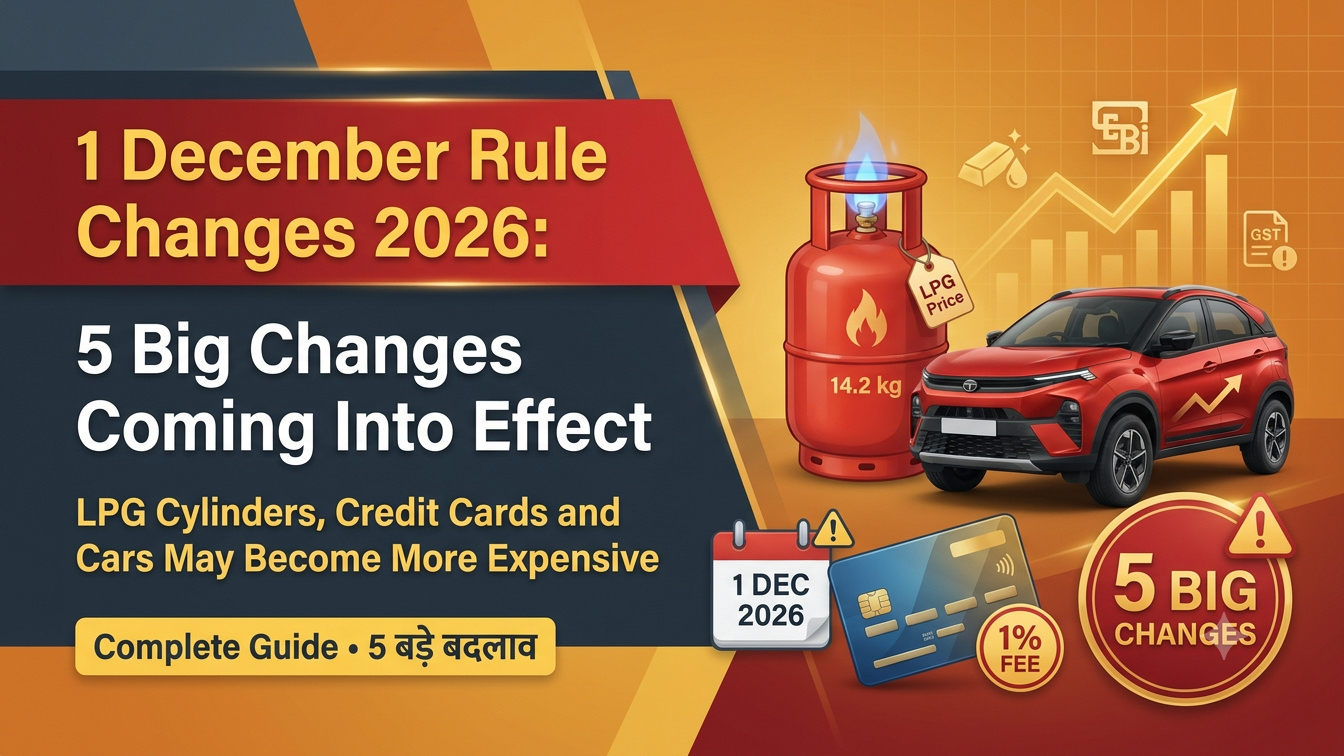
1 December Rule Changes 2026: The month of November is coming to an end, and December 2026 is just around the corner. Like every new month, several important financial and regulatory changes are expected to take place from December 1, 2026. These changes may directly affect the monthly budgets of ordinary households, credit card users, car buyers, stock market traders and business owners across India.
If you use an LPG gas cylinder at home, own an SBI credit card or are planning to purchase a new car, you should pay attention to these upcoming changes. Apart from household expenses, new developments related to SEBI regulations and GST registration procedures are also important for traders and business owners.
There are five major changes to watch out for from December 1, 2026. These include the monthly revision of LPG and aviation fuel prices, revised SBI credit card charges, a price hike for Tata Motors vehicles, changes in SEBI commodity trading margin requirements and a revised GST registration cancellation process.
Let’s take a detailed look at all five changes and understand how they could affect your finances.
1. LPG Cylinder Price: Gas Cylinder Rates May Change From December 1
One of the most important monthly changes that people across India watch closely is the revision of LPG cylinder prices.
Every month, on the first day, government-owned oil marketing companies review and announce the prices of LPG cylinders. Accordingly, new rates for domestic and commercial LPG cylinders may be announced on December 1, 2026.
Millions of Indian households depend on LPG for their daily cooking needs. Therefore, even a small change in gas cylinder prices can affect the monthly household budget.
In India, domestic LPG cylinders generally come in a 14.2 kg size, while commercial LPG cylinders are commonly available in a 19 kg size.
Domestic cylinders are mainly used in households, whereas commercial cylinders are used by hotels, restaurants, roadside eateries, catering businesses and other commercial establishments.
Domestic and Commercial LPG Prices Under Watch
Over the past few months, commercial LPG cylinder prices have experienced changes in different parts of the pricing cycle. Domestic LPG prices, meanwhile, have remained comparatively stable for certain periods.
On December 1, oil marketing companies may review LPG prices based on several factors, including international fuel prices, crude oil trends, currency exchange rates and other market conditions.
If domestic LPG prices increase, families may have to spend more on their monthly cooking expenses. Similarly, an increase in commercial LPG prices could raise operating costs for restaurants and hotels.
Businesses may eventually pass some of these additional expenses on to customers through higher food prices.
However, it is important to understand that an increase in LPG prices has not been confirmed in advance. The final prices will only be known after the official announcement by the oil marketing companies.
Aviation Turbine Fuel Prices May Also Be Revised
Along with LPG, the prices of Aviation Turbine Fuel (ATF) may also be reviewed on December 1.
ATF is the fuel used by commercial aircraft. Fuel expenses account for a significant portion of the operating costs of airlines.
If ATF prices increase, airlines may face higher operating expenses. Depending on market conditions, this could also influence domestic and international air ticket prices.
Therefore, passengers planning air travel in December should keep an eye on any changes in aviation fuel prices.
2. SBI Credit Card New Rules: Additional 1% Charges on Certain Transactions
The second major change is related to SBI credit card users.
Customers using eligible State Bank of India credit cards may have to pay additional charges on certain high-value transportation and fuel transactions under the revised fee structure.
According to the reported changes, an additional fee of 1% may apply to qualifying transactions that cross the specified limits.
This is particularly important for people who frequently use their credit cards for transportation payments or large fuel expenses.
1% Fee on Transportation Transactions Above Rs. 30,000
Under the reported revised structure, an additional 1% fee applies to eligible transportation transactions exceeding Rs. 30,000 in a single transaction.
For example, suppose a customer makes an eligible transportation payment of Rs. 35,000 using an SBI credit card.
A 1% additional charge would amount to Rs. 350. Applicable taxes may also be added to the fee.
This means customers making large transportation-related payments should carefully review the applicable charges before using their credit cards.
Additional Charges on Fuel Spending Above Rs. 50,000
Another important change concerns fuel transactions.
If eligible fuel spending exceeds Rs. 50,000 during a billing cycle, an additional 1% fee may apply under the reported terms.
For example, if a customer spends Rs. 60,000 on eligible fuel transactions during a billing cycle, the additional 1% charge would amount to Rs. 600, excluding applicable taxes.
This could affect customers who regularly use credit cards for high-value fuel purchases, including people with significant personal or business transportation expenses.
What Should SBI Credit Card Users Do?
Credit card users should understand the revised charges to avoid unexpected expenses.
Here are some important precautions:
- Check the latest fee structure applicable to your SBI credit card.
- Monitor your monthly fuel expenses.
- Review transportation payments before making large transactions.
- Check your credit card statement regularly.
- Compare alternative payment methods where appropriate.
- Visit the official SBI Card website for the latest terms and conditions.
It is important to note that these charges do not automatically apply to every credit card payment. They depend on the eligible transaction category and the specified spending limits.
3. Tata Motors Car Price Hike: Buying Tata Cars and SUVs May Become Costlier
The third major change is important for people planning to purchase a new car.
Tata Motors Passenger Vehicles has announced a price revision for its passenger vehicle range, with the new prices scheduled to take effect from December 1, 2026.
According to the reported announcement, the company plans to increase vehicle prices by an average of 0.5%.
The revision is expected to cover its passenger vehicle portfolio, including petrol, diesel and electric vehicles.
Which Tata Cars Could Become More Expensive?
Tata Motors offers several popular models in the Indian automobile market, ranging from affordable hatchbacks to premium SUVs and electric vehicles.
Some well-known models in its portfolio include:
- Tata Tiago
- Tata Tigor
- Tata Altroz
- Tata Punch
- Tata Nexon
- Tata Curvv
- Tata Harrier
- Tata Safari
- Tata Punch EV
- Tata Nexon EV
The price revision may affect different models and variants differently.
However, customers should remember that an average price increase of 0.5% does not necessarily mean that every vehicle will become exactly 0.5% more expensive.
The actual increase may vary depending on the model, variant and pricing structure.
Why Is Tata Motors Increasing Car Prices?
Automobile manufacturers depend on several raw materials and components to manufacture vehicles.
These include steel, aluminium, electronic components, batteries, tyres and other essential materials.
When the cost of these materials increases, the overall cost of manufacturing vehicles also rises.
Apart from raw materials, companies also face expenses related to transportation, logistics, manufacturing operations and other business activities.
Tata Motors has cited increasing input costs as a reason for its price revision.
The company is adjusting vehicle prices to manage the impact of higher production expenses.
What Should Customers Planning to Buy a Tata Car Do?
If you are planning to purchase a Tata vehicle in December, it is advisable to compare prices before and after the revision.
You should also contact an authorised dealership to obtain the latest price quotation for your preferred model.
Keep in mind that the ex-showroom price and on-road price are different.
The on-road price generally includes registration charges, insurance and other applicable costs.
Therefore, buyers should compare the complete on-road cost rather than looking only at the advertised ex-showroom price.
4. SEBI New Rules: Commodity Traders May See Changes in Margin Requirements
The fourth important development concerns people involved in commodity trading.
The Securities and Exchange Board of India (SEBI) regulates India’s securities market and introduces rules designed to improve transparency, market stability and investor protection.
Commodity derivatives trading involves contracts linked to commodities such as gold, silver, crude oil and other market products.
These markets can experience significant price fluctuations. Therefore, traders are required to maintain a certain amount of money as margin when entering into positions.
The reported changes from December 1, 2026, relate to margin requirements based on the risk associated with different commodities.
Margin Requirements Based on Commodity Risk
Under the reported framework, commodities may be classified into different categories depending on their price volatility and associated market risks.
The reported margin categories include:
- Low-volatility commodities: 6% margin
- Medium-volatility commodities: 8% margin
- High-volatility commodities: 10% margin
The objective of such a risk-based structure is to ensure that traders maintain sufficient funds to manage potential market losses.
The exact margin requirement for a particular contract can depend on applicable exchange and regulatory provisions.
How Will the New Rules Affect Traders?
Margin is the amount of money a trader must maintain with a broker or exchange to open or maintain a trading position.
For example, if a particular commodity contract requires an initial margin of 10%, traders may need to maintain the required amount according to the contract value and applicable rules.
If commodity prices fluctuate sharply, traders may face higher financial risks.
Risk-based margin requirements are intended to make sure that the amount of capital maintained by traders reflects the risks associated with their positions.
What Should Small and Large Traders Keep in Mind?
Both individual and professional commodity traders should pay attention to the revised requirements.
Before entering into a trading position, traders should:
- Check the latest margin requirements.
- Maintain sufficient funds in their trading accounts.
- Understand the risks associated with commodity price movements.
- Monitor their open positions regularly.
- Contact their brokers for contract-specific information.
Traders should also remember that margin requirements can change depending on market conditions and regulatory instructions.
5. GST New Rules: GST Registration Cancellation Process to Become More Digital
The fifth major change concerns businesses registered under the Goods and Services Tax system.
The GST framework is an important part of India’s indirect taxation system. Businesses registered under GST must follow various compliance requirements, including filing returns and paying applicable taxes.
In certain situations, businesses may need to cancel their GST registration.
For example, a business may close permanently, stop its commercial activities or become ineligible to continue under its existing registration.
The reported changes from December 1, 2026, concern the process of handling eligible GST registration cancellation applications.
Online Processing Through the GST Common Portal
The revised procedure is intended to make the cancellation process more digital and organised.
Under the reported amendments to the Central Goods and Services Tax Rules, 2017, eligible GST cancellation applications are expected to be processed electronically through the GST Common Portal.
This could make the application process more convenient for eligible taxpayers and reduce certain manual procedures.
However, the new system does not mean that every cancellation application will be automatically approved.
Applications will continue to be examined according to applicable GST provisions.
What Happens If GST Returns Are Pending?
Businesses with pending GST returns or outstanding tax liabilities may face additional scrutiny.
If an application involves unresolved compliance issues, it may be referred to the appropriate tax officer for examination.
This means business owners should ensure that their GST compliance is up to date before applying for cancellation.
The authorities may examine relevant records, outstanding payments and other details before making a decision.
What Should Business Owners Do?
Businesses planning to cancel their GST registration should take the following steps:
- Check whether all required GST returns have been filed.
- Review outstanding tax liabilities.
- Keep relevant business documents ready.
- Submit the cancellation application through the GST portal.
- Monitor the application status regularly.
- Respond to any notice or clarification request from the tax authorities.
The revised digital procedure may make the process easier for eligible businesses, while applications involving pending compliance issues may still require further examination.
How Will These Five Changes Affect Ordinary People?
The five changes expected from December 1, 2026, cover different aspects of everyday financial life.
The revision of LPG prices could affect household cooking expenses. Any increase in commercial LPG prices may also influence the operating costs of restaurants and hotels.
Changes in SBI credit card charges could affect customers who make high-value transportation and fuel payments.
The Tata Motors price revision may increase the purchase cost for people planning to buy a new car or SUV.
Meanwhile, SEBI’s reported commodity margin changes are particularly important for people involved in futures and derivatives trading.
The revised GST cancellation procedure may help eligible business owners complete certain registration-related formalities through a more digital process.
Although these changes do not affect every Indian in the same way, they are important developments to watch as the new month begins.
Important Things to Check Before December 1, 2026
To avoid unexpected expenses and compliance-related problems, individuals and businesses should take a few precautions.
- LPG users: Check the latest domestic and commercial cylinder prices after the official announcement.
- SBI credit card users: Review the revised fee structure and understand the transaction limits.
- Car buyers: Contact Tata Motors dealerships and compare updated prices for different models and variants.
- Commodity traders: Check the latest SEBI and exchange margin requirements before placing trades.
- GST-registered businesses: Review pending returns, tax liabilities and the updated registration cancellation procedure.
Taking these precautions can help individuals and businesses plan their finances more effectively.
Conclusion
December 1, 2026, is an important date for consumers, vehicle buyers, credit card users, commodity traders and business owners.
The five reported changes include possible LPG and aviation fuel price revisions, additional SBI credit card charges on specified transactions, a Tata Motors vehicle price increase, revised SEBI commodity margin requirements and changes to the GST registration cancellation process.
These developments could influence household budgets, vehicle purchase decisions, banking expenses and business compliance.
Therefore, it is important to understand the applicable rules before making financial decisions. Keep checking official announcements from the concerned companies, banks and regulatory authorities to stay updated.
Being informed about these changes can help you manage your expenses and prepare for the new month without unnecessary financial surprises.
